
Have you ever found yourself not knowing what to write in your CV and fearing that it won’t convince recruiters? Do you feel that you have a lot to offer professionally, but you’re not sure how to express it in a document that catches a recruiter’s attention? You’re not alone. A CV model can guide you in selecting the information from your career that shows you’re the right candidate for the future job.
In 2025, over 68% of candidates (according to LinkedIn) stated that they feel insecure about how they should structure their CV, especially since artificial intelligence and automated CV-screening platforms are increasingly present in recruitment. This insecurity is also fueled by the fact that, according to Glassdoor Research 2025, 7 out of 10 candidates fear their CV will not be “seen” by a human recruiter, but automatically filtered by ATS (Applicant Tracking Systems).
But it’s not just about algorithms. The LinkedIn Global Talent Trends Report 2025 mentions that 81% of employers value the candidate’s skills and growth potential more than the list of experiences. These data show that in 2026, a CV should tell a clear story about who you are and what you can bring to a team — not just where you worked. Aceste date arata ca in 2026, CV-ul ar trebui sa spuna o poveste clara despre cine esti si ce poti aduce in echipa – nu doar unde ai lucrat.
In this article, you will discover:
- What a CV model is and why you need one
- What a 2026-updated CV model looks like, aligned with recruiter expectations
- What information to include in each section and what to remove
- How to structure your information to stand out to both humans and algorithms
- CV models — What you can learn from them
- What information you should include depending on your career level
- Do's & Don'ts in CV;
- What new trends influence CVs and how you can adapt
What is a CV Model and Why You Need One
A CV model is more than a simple graphic template — it is the basic structure that helps you tell your professional story in a clear, organized, and convincing way. In 2026, a well-built CV model means content and design tailored to the job you are applying for and digital compatibility (with recruitment platforms and ATS systems).
Think of it as a map showing you what information to include and in what order, so the recruiter can easily find what they’re looking for. A good model saves you hours of uncertainty — you know exactly what to select from your experience and how to present it. Follow a CV model whether you’re just starting out or you already have a well-established career. It’s the first impression about you that can convince a recruiter to call you for an interview.
What a 2026-updated CV model looks like, aligned with recruiter expectations
In 2026, a CV is no longer just a list of experiences and diplomas. Recruiters seek relevance, clarity, and authenticity, wanting to quickly understand who you are and whether you fit the organizational culture.
According to a recent report published by Indeed, 73% of HR specialists use ATS (Applicant Tracking Systems) to filter CVs. This means that the structure, keywords, and format of the CV can make the difference between being selected or ignored.
CV Model 2026 — Key Elements of a Convincing CV
Clear Structure and Balanced Layout
- Well-defined titles and sections: Professional Profile, Experience, Education, Skills, Relevant Projects.
- Spacing and legible fonts, with no text overcrowding.
- Include subtle visual elements (charts, icons) to highlight achievements, but without compromising ATS readability.
Keywords and Role Alignment
- Adapt the CV for each job you apply to, using the keywords and skills mentioned in the job description.
- ATS systems identify these keywords, and including them can increase your chances of being selected.
Focus on Achievements and Impact
- Highlight results, not responsibilities: increased sales, improved efficiency, successful projects.
- Use numbers and metrics whenever possible to demonstrate added value.
Authenticity and Cultural Compatibility
- The professional profile should reflect not only your skills but also your values and attitude.
- Recruiters look for clues on how you integrate within a team or organization.
Digital Format and ATS Compatibility
- Avoid overly complex graphic elements that hinder automated reading.
- Include links to online professional profiles or portfolios, if relevant.
- Save your CV as a PDF.
A 2026 CV is more than a list of jobs: it is a strategic tool for showcasing your value, adapted both to automated reading and quick evaluation by recruiters. Simplicity, clarity, and relevance will be decisive factors.
Contact Information & Professional Photo
Your CV contact details should include your full name, a professional email address (with your name), phone number, and a link to your LinkedIn profile or portfolio.
The photo should be simple: neutral background, natural light, subtle smile, business-casual attire. In creative industries like marketing, design, or communication, the photo can be more creative. But in fields like banking or medicine, most recruiters prefer business-style photos.
About Me & Professional Objective
This is the first impression about who you are and what you aim to bring to the company you’re applying to. Avoid generic phrases like: “I am an ambitious and results-oriented person.” Instead, say something authentic:
For example:
“I am oriented toward continuous learning, passionate about projects that combine analysis and creativity. I want to work in a team where I can bring value through concrete solutions, not just ideas.”
Why this approach matters: the work environment has changed, and soft skills have become essential. For example, according to LinkedIn Corporation’s “Skills on the Rise 2025” report, seven of the top ten fastest-growing skills are human skills such as adaptability, conflict resolution, innovative thinking.
Therefore, this section isn’t just “decorative” — it’s an indicator of who you are as a person.
Work Experience
This is the most important part of the CV. Here you want to show what you actually did, not just your responsibilities. Include: job title, company, period, but especially your achievements — ideally quantifiable:
“I coordinated a team of 5 people and increased sales by 25% in 6 months.”
“I implemented an automated process that reduced work time by 40%.”
If you’re at the beginning of your career, include internships, volunteer work, or relevant personal projects — and explain what you learned and produced. Create a CV that shows what you can offer, not just what you did.
Education & Certifications
Education remains important, but in 2025–2026 the focus shifted from degrees to relevant certifications, online courses, and micro-credentials. The OECD 2025 report shows that many countries are transitioning toward a skills-first approach where companies look more for competencies than academic titles.
If you studied on Coursera, Udemy, or earned Google certifications, include them to show qualification and adaptability. Mention the institution, certification, year, and optionally what hands-on work you did.
Foreign Languages
Regardless of the job you’re applying for, knowing a foreign language has become a hiring requirement. Include the language and proficiency level (A1–C2 or simple: beginner, intermediate, advanced, fluent). If you have official certificates (Cambridge, IELTS, TOEFL, DELF, Goethe, etc.), list them. If you apply to international companies, write your CV in the same language as the job posting.
Skills (Hard & Soft Skills)
This section is increasingly important in 2026. It’s no longer enough to have technical skills — human (soft) skills such as adaptability, critical thinking, empathy, and communication are essential.
For example:
- According to the “Curious, Critical Thinker” study from January 2025, soft skills such as curiosity, empathy, awareness, and ethics are just as important as technical expertise.
Why? Hard skills can be learned — soft skills show your ability to collaborate, adapt, and handle challenges.
Model CV with soft skills:
- Mention hard skills relevant to the job (e.g., Excel, Analytics, CRM, project management).
- For soft skills, don’t just write “communication” or “adaptability” — also show a concrete achievement demonstrating that skill.
Hobbies, Projects
This section shows who you are beyond the job. If you participated in volunteer programs (e.g., digital education), team sports (discipline, teamwork), or personal projects (blog, open-source, podcast, photography), these show initiative. Avoid generic hobbies like “music” or “movies,” unless directly relevant. Evita hobby-urile generice ca „muzica” sau „filme”, decat daca au o relevanta directa pentru rolul vizat.
CV Design Matters — Not Just Content
A 2025 Canva study shows that a well-structured CV is 32% more likely to be fully read. Recruiters skim quickly, and a clean, airy CV with clearly divided sections makes the difference.
Simple rules:
- Choose a clear, readable font (Calibri, Lato, Roboto, Arial).
- Avoid strong, flashy colors — use subtle accents only for titles or separators.
- Maintain spacing between sections. White space helps readability.
- Save as PDF to preserve formatting.
A well-designed CV signals organization, attention to detail, and respect for the reader’s time — a subtle message about your professionalism.
The average time a manager spends reviewing a CV is 2 minutes and 17 seconds. (CV & Cover Letter Trends Survey – CV Genius) 2 minute și 17 secunde. (CV & Cover Letter Trends Survey - CV Genius)
What Else You Should Add to Your CV to Stay Relevant
1. Link to LinkedIn Profile or Portfolio
Why it matters:
- A CV shows your experience and skills. A LinkedIn profile or online portfolio shows your projects and recommendations.
- Recruiters often check LinkedIn after a CV passes the first filter.
- For technical or creative roles, a portfolio (personal website, GitHub, Dribbble, etc.) makes a big difference.
Recommendation:
- Add the link at the top or in the Contact section. Example: LinkedIn: linkedin.com/in/name / Portfolio: www.projectname.com
- Make sure your LinkedIn is updated and consistent with your CV.
- If you have a portfolio: choose 2–3 important projects with images and short descriptions.
- Important: Verifica ca link-urile sa fie functionale!
75% of recruiters use ATS (HQ Hire), and only 25% of CVs pass this first filter before being seen by a human (Instant Offices).).
2. Keywords from the Job Posting
Why they matter:
- Most companies use ATS to screen CVs. A study (ijirt.org) shows that CVs optimized with relevant keywords, a simple format, and a clear structure had more than twice the chances of being shortlisted by employers.
- If your CV lacks the keywords the employer seeks, it may be filtered out automatically.
- A personalized CV shows that you are a committed, detail-oriented person who is eager to make a difference in your work.
How to identify and use keywords:
- Read the job posting carefully: “Requirements,” “Responsibilities,” “Desired skills.”
- Note recurring words — technologies, abilities (“communication,” “leadership”), industry terms (“fintech,” “e-commerce”).
- Imparte cuvintele cheie in mod natural. Include-le in profilul personal, in zona de competente, in experienta, in rezultate.
- Don’t overstuff keywords — ATS systems detect unnatural language.
3. Certifications
Why this subsection is valuable:
- Listing roles and responsibilities is no longer enough. Employers want concrete proof of performance.
- Professional certifications show competence and a desire for continuous development. A Coursera study found that people who listed their credentials had ~6% higher chances of getting a new job and ~8% higher chances that the job matched the certification (arxiv.org).
Recommendations:
- Certificari si rezultate: mentioneaza numele certificarii, organismul emitent, anul obtinerii, si un scurt exemplu de aplicare in proiect. Ex: „PMP® – Project Management Institute, 2025. Am aplicat metodologii de gestiune risc in proiectul de ERP, reducand intarzierile cu 15%.”
- Show relevance to the targeted job.
- Highlight achievements from the last 2–3 years.
Quick Summary & Checklist
✔️ Include a LinkedIn/portfolio link: updated, professional.
✔️ Select job-specific keywords and integrate them naturally.
✔️ Mention relevant certifications + quantifiable results.
CV models — What you can learn from them
Looking for inspiration for your own CV? We’ve gathered several models. We analyzed each to show what makes them effective, their strengths, and where they can be improved. The goal? To help you understand what a CV that not only informs but impresses should look like.
Whether you're just starting out or updating your professional profile, these examples can offer concrete ideas about structure, design, and what sets you apart.
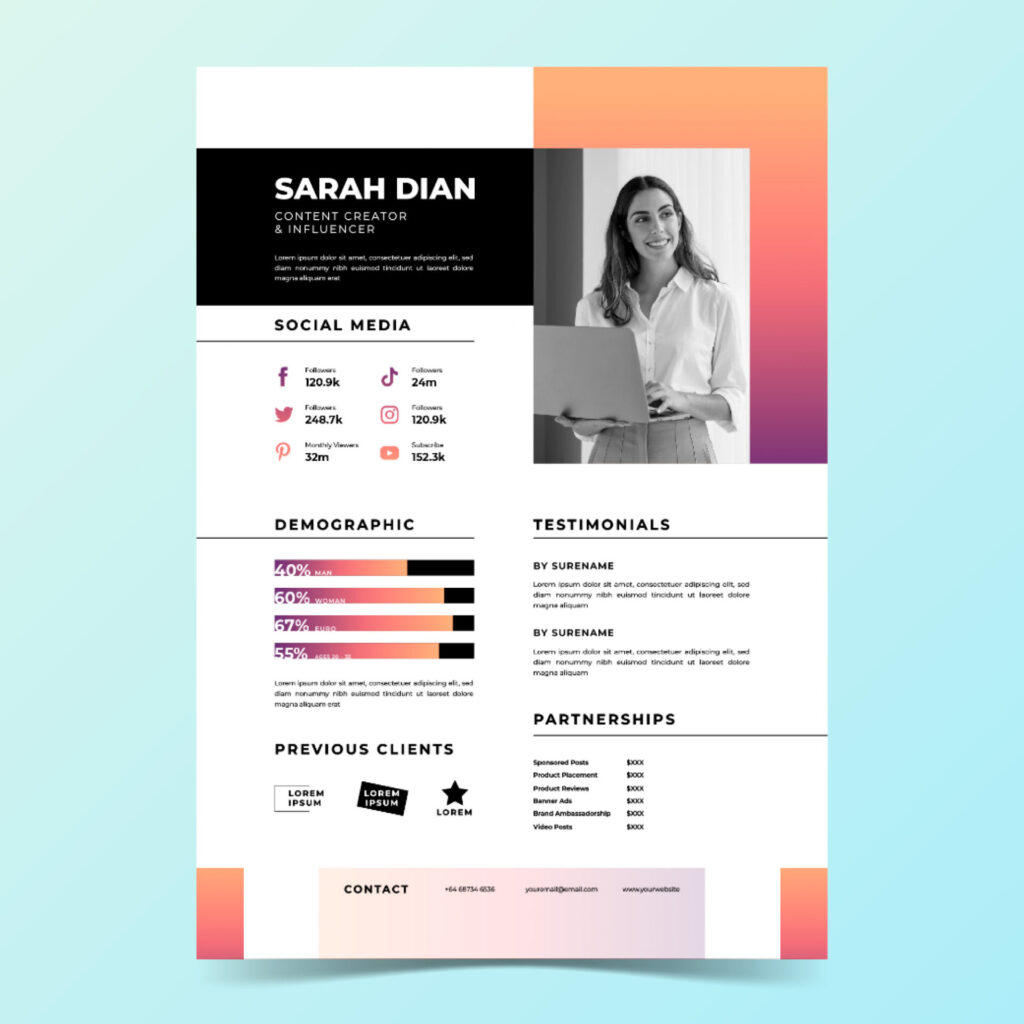
CV for Content Creators and Digital Marketing
Example: “Sarah Dian – Content Creator & Influencer”
✔️ Strengths:
Simple design with warm gradient — friendly and visually appealing.
Includes relevant sections: Social Media, Demographics, Testimonials, Partnerships.
Uses numeric data (followers, reach, engagement) that give credibility.
⚠️ What can be improved:
Mention preferred platforms and content types (video, photo, blogs).
Add links to social networks or portfolio.
- Replace generic text with short, relevant descriptions of projects and achievements.
💡 Recommendation:
Great for freelancers, marketers, influencers, and specialists in social media or personal branding.
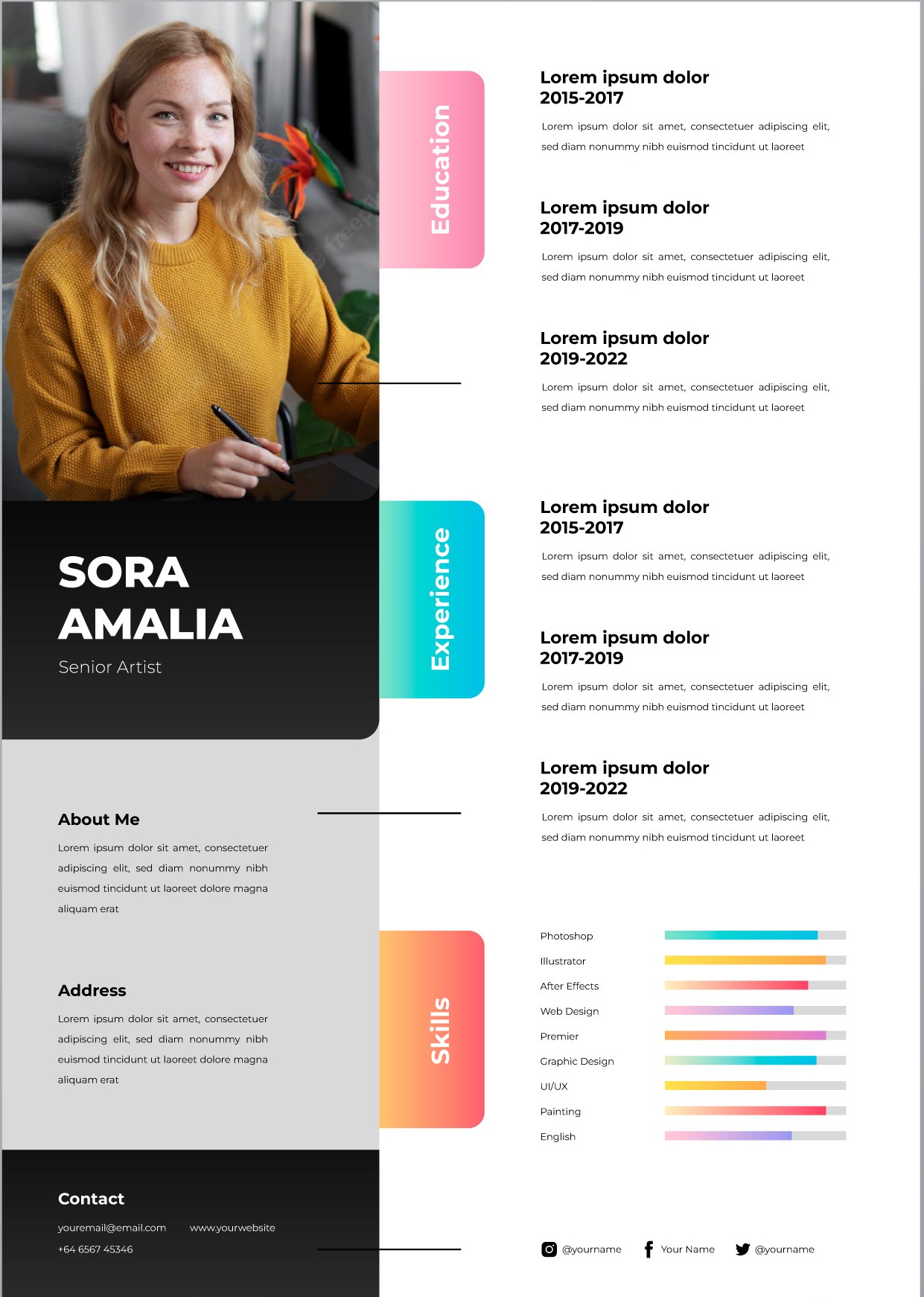
Creative CV — for Artistic or Visual Fields
Example: “Sora Amalia – Senior Artist”
✔️ Strengths:
Attractive, colorful but balanced design — conveys creativity.
Clear structure with well-defined sections (Education, Experience, Skills).
Visual skill bars (Photoshop, Illustrator, etc.) make information easy to understand.
Professional, expressive photo that creates a personal connection.
⚠️ What can be improved:
Avoid using too many strong colors; limit to 2–3 dominant tones.
Replace generic text with short, relevant descriptions of projects and achievements.
💡 Recommendation:
Ideal for designers, illustrators, architects, digital artists — fields where the CV should reflect creativity and personal style.
What Information to Include in Your CV, Depending on Your Career Level
Regardless of your career stage, the golden rule remains the same: relevance to the role you’re targeting. A generic CV no longer works in 2026. Discover what information you should include in your CV depending on your level of experience.
Entry-Level (0–3 years of experience)
If you’ve just graduated or have a few years of experience, focus on your education, projects, internships, and relevant courses. Employers know you may lack extensive experience, so they want to see curiosity, involvement, and results—even from non-formal contexts.
What to include:
- Recent education, listing your specialization and relevant projects.
- Personal or academic projects that demonstrate applicable skills: “I developed a web application for managing the campus library using HTML, CSS, and JavaScript.”
- Internshipuri sau voluntariat, cu rezultate masurabile: "Am realizat un studiu de piata care a fost folosit in campania X, contribuind la cresterea engagement-ului cu 15%"
- Relevant online courses and certifications: Google Analytics, UX Design, Python, Project Management, etc.
- Soft skills: communication, teamwork, adaptability.
Recommendations:
- Foloseste sectiunea "Obiectiv profesional" pentru a arata dorinta de invatare si orientarea spre rezultate:
- "Caut o pozitie de Marketing Assistant unde pot contribui cu idei creative si invata din proiecte"
- Be specific: instead of “participated in marketing projects,” say “created social media content that increased reach by 20%.”
Mid-Level (3–8 years of experience)
At this stage, your experience carries more weight. Recruiters want to see your concrete accomplishments, the impact you’ve had, and the competencies you’ve developed. The focus shifts from what you did to what results you achieved.
What to include:
- Roluri relevante, cu responsabilitati si rezultate masurabile:
- "Am coordonat o echipa de 5 persoane si am implementat un proces de raportare care a redus timpul de lucru cu 30%"
- Proiecte cheie, cu impact pe business:
- "Am condus campania de lansare a produsului X, contribuind la cresterea vanzarilor cu 25% in primele 3 luni"
- Coordination and collaboration skills: project management, training juniors, delegating tasks.
- Sectiunea "Obiectiv profesional" poate fi scurta si sa arate exact ce iti doresti:
- "Caut oportunitati in management de proiect unde pot coordona echipe si livra rezultate cuantificabile"
Recommendations:
- Focus on the impact of your work—the numbers and tangible improvements you generated.
Senior Level (Specialist / Manager) (8+ years of experience)
At an advanced level, your CV should communicate expertise, leadership, and strategic vision. Recruiters look not only at what you’ve done, but also at how you’ve influenced your team, organization, and company strategy.
What to include:
- Realizari la nivel de echipa si organizatie:
- "Am implementat o strategie de transformare digitala care a crescut eficienta departamentului cu 40%"
- "Am coordonat lansarea unui produs pe 3 piete internationale, crescand cota de piata cu 12%"
- Leadership and mentorship: team development, coaching, delegating responsibilities.
- Strategic projects and quantifiable outcomes.
- Profilul "Despre mine" ar trebui sa arate expertiza, viziunea si abordarea orientata spre rezultate:
- "Manager cu peste 12 ani experienta in logistica si supply chain, pasionat de optimizarea proceselor si dezvoltarea echipelor performante"
Recommendations:
- Don’t detail every job you’ve ever had; focus on the ones with real impact.
- Include concrete numbers and achievements to make your CV memorable.
- Highlight leadership and strategic decision-making.
Do’s and Don’ts CV
When writing your CV, it’s easy to fall into the trap of including too much information or losing clarity. Recruiters receive dozens—sometimes hundreds—of applications for a single role, and your CV needs to stand out. Here’s how to do it right:
Do’s
- Include measurable achievements
Don’t just describe what you did; show the impact: “Increased sales by 30% in one quarter” or “Implemented a process that reduced delivery times by 2 days.” - Tailor your CV to each job Every employer is looking for something specific. Adjust your sections, skills, and examples to match the job description. Generic CVs no longer work in 2026—especially with ATS filters.
- Use a clean, professional format Save your CV as a PDF, use readable fonts, and include bullet points. A clear structure helps both recruiters and AI scan the document quickly.
- Be honest False or exaggerated experiences can be easily detected through interview questions and tests. Honesty builds trust and protects your professional reputation.
- Check your online profiles Your photo, description, and professional activity online should align with your CV. Employers verify LinkedIn and digital portfolios; consistency signals professionalism.
Don’ts
- Don’t include irrelevant or outdated information Avoid generic objectives like “Seeking a challenging role” or hobbies that don’t add value. Personal details (address, age, marital status) are no longer required in many countries.
- Avoid large blocks of text Your CV should be easy to scan. Use bullet points so your achievements and skills stand out.
- Avoid decorative fonts or graphics Bright colors, excessive icons, or hard-to-read fonts can confuse both ATS systems and human readers. Professionalism comes from clarity—not design overload.
- Don’t send an outdated CV An old, unrefreshed CV may give the impression that you’re not truly invested in the position.
- Don’t rely only on AI If you use AI tools, review the content carefully. Generic text is easily identifiable by recruiters. Personalize everything and ensure it reflects your real experience.
CV Trends for 2026
The way recruiters and selection systems evaluate your CV is changing. In 2026, automation will play a larger role in CV screening. It’s no longer enough to list experiences and responsibilities—you need to show impact, adaptability, and future-facing skills, both for humans and algorithms.
AI optimization becomes the rule, not the exception
- ATS systems in 2026 can understand not only keywords but also competencies, achievements, and behavioral patterns (Resumekraft, 2025).
- This means that a well-structured CV can be quickly read by both an algorithm and a recruiter.
What this means for you: Use keywords from the job description and highlight concrete results. For example, instead of “responsible for digital marketing,” write: “Implemented digital marketing campaigns that increased engagement by 25%.”
Personal branding and interactive portfolios
- Do you have an online portfolio? Include it early in your CV. According to Resumekraft (2025), links to online portfolios, personal websites, or platforms like GitHub, Behance, or Medium are becoming the norm.
- What you can do: Add a short, clear link to your projects so recruiters can see real examples of your work before the interview.
Authenticity and storytelling
- Business Insider (2025) warns about the “uniformity epidemic” in CVs—overuse of AI generates documents that sound identical and lack personality.
- What you can do: Use your “About Me” section to share who you are, what drives you, and how you’ve contributed to your teams and projects. Add a human touch.
Results-first, not tasks-first
- Studies show that highlighting your concrete impact significantly increases your chances of getting interviews (Reddit – Job Search Hacks, 2025).
- What you can do: Structure your achievements like this: “I achieved X” + “by doing Y” → quantifiable result Z” Example: “Reduced costs by 12% by renegotiating supplier contracts.”
Transferable skills and critical thinking
- 73% of talent acquisition leaders consider critical thinking and problem-solving top recruitment priorities for 2026 (Korn Ferry, 2025).
- What you can do: Highlight skills such as critical thinking, problem-solving, leadership, collaboration, and cross-functional teamwork—along with examples that prove you truly possess them.
Skills-first hiring and micro-certifications
- An EDLIGO report shows that 85% of employers have adopted skills-based hiring over traditional degree-based evaluation.
- What you can do: Include relevant certifications, online courses, or projects that demonstrate applied competencies—even if they come from outside formal work experience.
76% of recruiters accept two-page CVs, and 88% consider longer CVs normal for senior professionals (BetterResume).
Frequently Asked Questions About CVs & the 2026 CV Model
How many pages should a 2026 CV have?
Ideally 1–2 pages. If you have under 5 years of experience, one page is enough. For senior or management roles, recruiters recommend two pages.
What design should I choose?
Opt for a clean, simple design. Avoid strong colors and unnecessary graphics. Use a logical structure and bullet points.
What does an AI-optimized CV mean?
More companies use ATS systems to filter CVs automatically. To increase your chances:
include keywords from the job description
use a simple format (PDF with readable text, not an image)
fill in all standard sections
Can I use AI to write my CV?
Yes, but don’t rely on it entirely. Use AI for structure and wording ideas, then personalize the content.
What sections are mandatory?
- Contact information (professional email, phone number, LinkedIn)
- About Me / Career Objective
- Work Experience
- Education
- Hard and soft skills
- Foreign Languages
- Optional: certifications, projects, volunteering, portfolios
What should I avoid including in 2026?
Personal information such as your date of birth, marital status, or full address. Also, avoid generic objectives or irrelevant hobbies.
How often should I update my CV?
Ideally every 6 months, or after any major project, certification, or role change.
How important is my online profile (LinkedIn, portfolio, personal website)?
Very important. 90% of recruiters check candidates’ online profiles before interviews (Resumekraft, 2025).
Do I need a cover letter?
Yes—especially if you’re early in your career, switching fields, or applying for competitive roles.
Can I use the same CV for multiple industries?
You can use the same base template, but you should tailor the content for each role or field. Personalization increases selection chances by over 40% (LinkedIn, 2025).
How Smartemp helps job seekers
We have strong recruitment and HR consulting experience, and we work with empathy, tailoring each program to your career expectations. In a time when economic changes require rapid adaptation, career counseling is one of the safest ways to turn uncertainty into opportunity.
Our involvement goes far beyond simply rewriting your CV. We work with you to understand what you really want, identify hidden opportunities on the job market, and prepare you to significantly increase your chances of success. In our career counseling program, you benefit from:
One-to-one sessions analyzing your career path and aspirations.
A strong CV and LinkedIn profile that capture attention.
Access to job opportunities aligned with your profile
Networking strategies and interview preparation.
Support with onboarding into your new role to ensure a smooth transition.
📩 Write to us at office@smartemp.ro and start your professional (re)discovery process today.
A perfect CV may not exist, but a CV that authentically reflects your professional identity does. In 2026, a truly effective CV presents your narrative with clarity, structure, and direct relevance to the role you aim for. Recruiters evaluate more than qualifications—they seek individuals who can integrate into their teams. Ensure your CV conveys the professional you are beyond the written words.
Sources:
- LinkedIn Global Talent Trends Report 2025 – “Skills First Hiring and AI-Driven Recruitment”
- Indeed Hiring Insights 2025 – “The Future of Resume Screening with AI”
- Glassdoor Research 2025 – “The Rise of Microcredentials in Hiring”
- Forbes Careers 2025 – “Soft Skills Are the New Hard Skills”
- Canva Design Trends Report 2025 – “Visual Simplicity and Resume Readability”
Read also:
Were You Laid Off? Here’s How to Write a CV That Helps You Get Hired Faster
How to Stand Out When Competition Is High for a Temporary Job